Modules · For everyone on the floor
Identification and traceability
How the work moves
Traceability- 1Identify lot or serial
- 2Connect material and process
- 3Record movement
- 4Trace both directions
Identification Traceability and Inspection Planning: identification and traceability. This is part of chapter 23 of the NormaQMS User Guide.
Identification and Traceability
Open: More > Identification & Traceability. Typical leads: QA Technician and Quality Manager. Create a TR record for a Lot, Batch, Serial, Unit, Material, or Device. Enter the identifier and available product or source references so the record can be matched to physical identification.
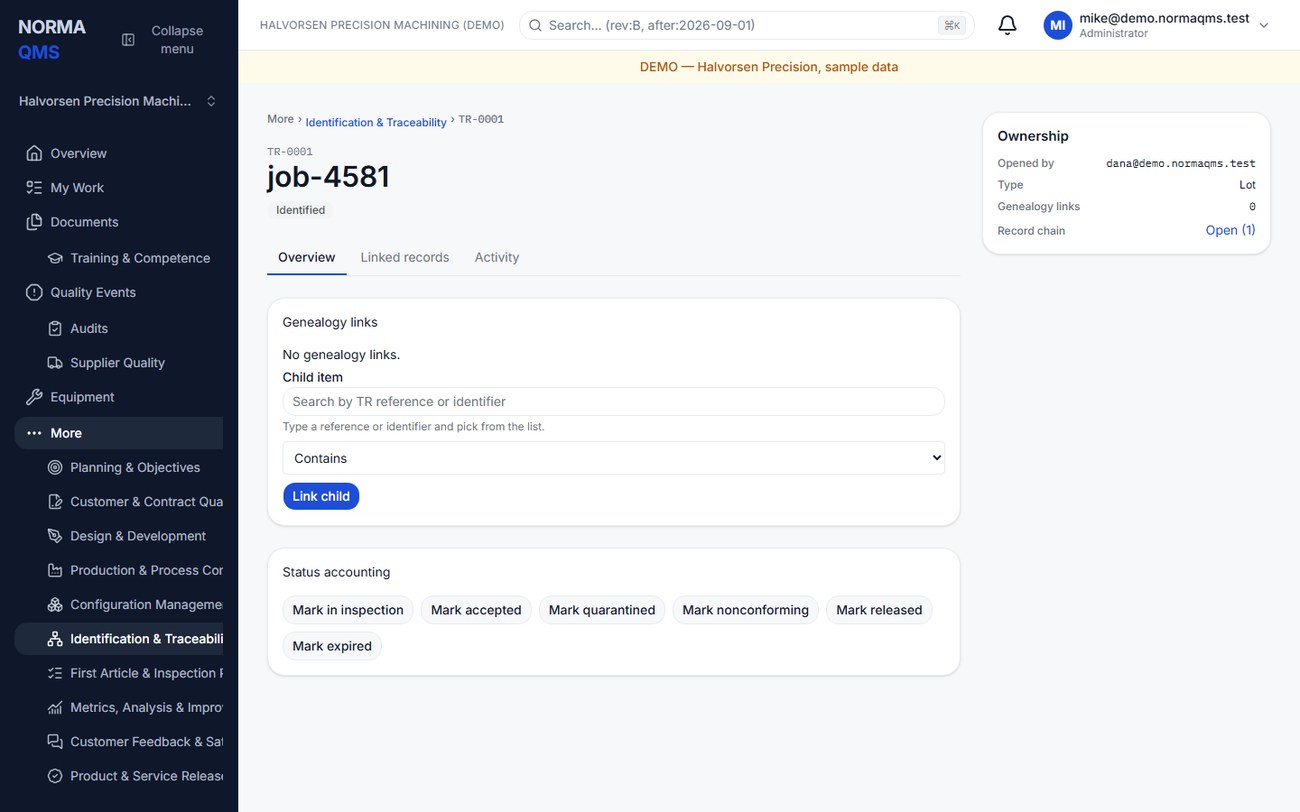
- Choose Identify item, entering the identifier, type, and the source or supplier, work order and customer references. Confirm its identity before changing quality status.
- Use the Mark … controls. The normal route is Identified, In inspection, Accepted, then Released.
- Use Quarantined or Nonconforming when appropriate. Quarantined items can return to inspection or an allowed dispositioned state; Nonconforming items can return to inspection or quarantine. Expired is terminal.
- On the parent item, type the child's TR reference or identifier in Child item, pick it from the list, choose the relationship, and select Link child.
- Check the genealogy list and chain to confirm that the intended records were connected.
Relationships are Contains, Consumes, Transforms, Splits, and Merges. Both items must be valid records in the organization. A typed lot reference in a note is not a genealogy link.
You cannot jump directly from Identified to Released. Released items have a limited onward path, including expiry; use the appropriate NC or event workflow if a new problem is discovered after release. Traceability does not maintain warehouse quantities or automatically recall affected stock.
In the user guide
This article is part of chapter 23, "Identification Traceability and Inspection Planning", of the NormaQMS User Guide (NORMA-UG-001), which is under Help > User guide. Chapter numbers in the text refer to that guide. The same chapter also covers: First Article and Inspection Planning.